
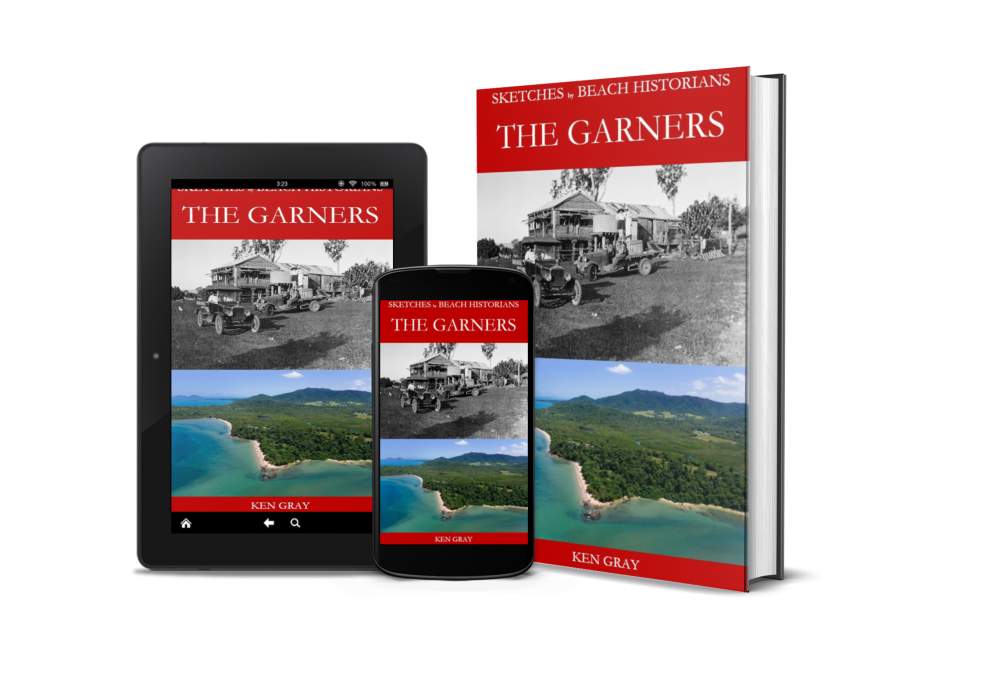
Author: Ken Gray
Editors: Margaret Remilton, Rhonda Jarvis, and Diane Bull.
 |
Abridged Story | |
Full Story |
The fine Royal Mail Ship Merkara sailed toward Australia, carrying Ted and Edith Garner and their 18-month-old son toward an uncertain future. They had boarded in London in 1899, full of hope and excitement, leaving behind the familiar streets of England's midlands for a land they knew only through letters and newspaper accounts
Young Ted (EH), Edward Henry Garner, would retain no memory of that momentous voyage. Ocean travel in 1899 carried real dangers. A year later, the Merkara's sister ship, the Quetta, sank near Thursday Island with significant loss of life.
The contrast between their origins in urban Nottingham and their eventual destination, a remote North Queensland beach, could not have been starker. The Garners would be the first European settlers at this beach.
Ted (ET, Edward Thomas) Garner was born in Nottingham in 1861 and married Edith Johnson in 1887. Edith came from the village of Yoxall, not far south of Nottingham, and was just eighteen when they wed.
The family's lived initially in southeast Queensland and northern New South Wales, moving as work demanded. Their second child, Elizabeth Ann, known as Lizzie, was born in 1891 near Toowoomba. Their third child, Nellie, arrived in 1894 at Karuah in the Hunter Valley.
Ted's early work as a fencing contractor didn't satisfy him for long. The sea called him back. His father, Henry Garner, worked for the British railway as a Canal Lockkeeper, and that is where Ted acquired his great love of boats and the sea. He moved the family to Sydney where he worked as a ships master, trading between the Parramatta River and Newcastle.
Constance Mackness said of Ted: the sea was in his blood for he had run off to be a ship's boy when a mere child. By 1902, the Garners had settled in Cardwell, where Ted traded between Cardwell and Geraldton (Innisfail) and ferried cargo for Chinese banana farmers on the Hull River.
During Cyclone Leonta in 1903, Ted (ET) and his son Ted (EH) were sailing near Hinchinbrook Island with a Kanaka deck hand when their boat was wrecked, leaving them stranded on an inhospitable island. For a week, they walked around the island without food or shoes. Finally, after seven days of desperate searching, they discovered an old, abandoned boat in the channel. Though barely seaworthy, it was enough to carry them back to the mainland.
A lesser man might have reconsidered his career after such an experience. Ted Garner's response was characteristic: within a month, he had built a bigger boat. The 30-ton steamship Enterprise soon had them back in business.
In 1905, the Garners selected land on the Murray River north of Cardwell. They built a sawmill to make packing cases for banana farmers, cleared land, and established their own banana plantation. Lizzie married Lou Wildsoet, and in 1909 the extended family relocated to Bingil Bay to operate the Cutten timber mill. While there, Ted (EH) and his wife Carrie welcomed their second son, Frank, the first European child born in the district.
The timber venture was soon abandoned, but by then Ted and Edith had fallen in love with the area. In late 1910, they took up a forfeited selection at what would become Garners Beach. Nearby Muff Creek provided safe mooring places for Ted’s boats, always his first consideration.
Ted (ET) received a 20-year agricultural lease on Lot 10v in December 1910. The property was covered with valuable timber, and they immediately set to work. Ted junior, Lizzie and Lou's families, with Cousin Arthur Garner, and one of Edith's brothers joined them at their new settlement.
They cleared land and planted bananas and pineapples. Ted soon returned to transporting cargo throughout the district using Maria, Muff and Liverpool Creeks. They maintained the navigation lights in the creeks, a responsibility that fell to brave young Nellie Garner, who ventured out alone at night through crocodile-infested waters.
The Garners built several boats on their land, some up to 60 feet long. They had a boat named the Swan and used it to blast Kings Reef for coral, which they burned and transported to Innisfail as fertilizer for cane farmers.
They took five years to clear and plant 40 acres. By 1911, they had built two homes, eventually constructing four from timber frames with galvanized corrugated iron roofing. They named their property Wilford Hill because their first house, built on the small rise on the south headland, reminded them of a similar hill near Nottingham.
When World War I erupted, coastal shipping was lost and farming became impossible. Only Ted, Edith, and Nellie stayed on at Wilford Hill. Arthur served at Gallipoli, and Ted (EH) moved to Silkwood hauling logs.
The 1918 cyclone destroyed their house but they soldiered on. When the railway opened at El Arish in 1924, Ted returned to his cargo boats with daughter Nellie's help.
Edith Garner established the district’s first holiday accommodation in 1924, beginning with five galvanized iron huts and later adding two cottages. The venture was an instant success. As the Depression deepened, the Garner family's generosity was fully revealed. They threw open their accommodation and fruit farm to destitute families, allowing them to stay until they recovered, then welcoming others in their place. By then, they had built a new five-room home on Wilford Hill and re-established their banana and citrus plantations.
Many people who later met family members spoke warmly of the family's Depression-era kindness. The consensus was clear: the Garners sent no one away, and nobody went hungry if they happened upon this coastal oasis.
Edith Garner died on 24 August 1935 at 68 years of age. Few in Mission Beach today realize that Edith was the pioneer of tourism. She was buried in a private cemetery at Wilford Hill. which is now Queensland Heritage listed.
Ted junior’s wife Carrie died in a car accident in 1937 while returning from El Arish. Ted (ET) retired to Tully and assigned his agricultural lease to his son in 1937. In 1942, Ted junior remarried, this time to Gerty Cooper.
Ted and Gerty focused on fishing tours to the Reef, the first in the district to offer such excursions. When World War II came, six family members enlisted and served. After the war, Ted’s sons returned and continued the tourism ventures, building a 45-foot boat they named Day Spring. The Garner entrepreneurial spirit lived on in a third generation.
Ted (ET) Garner died on 4 July 1945 and was buried at Wilford Hill beside Edith and Carrie. Two other family members would later join them in that small cemetery: Ted (EH) in 1965 and his son, E.C. (Ned) Garner in 1968.
The Garners came to Australia with little more than hope and determination and were a great success. Today, visitors to Garners Beach walk on sand near where the Garners first lived, swim in waters they first navigated, and enjoy a coastline they first shared with others. That may be the most fitting legacy of all, and who can forget what this family did in the Depression?
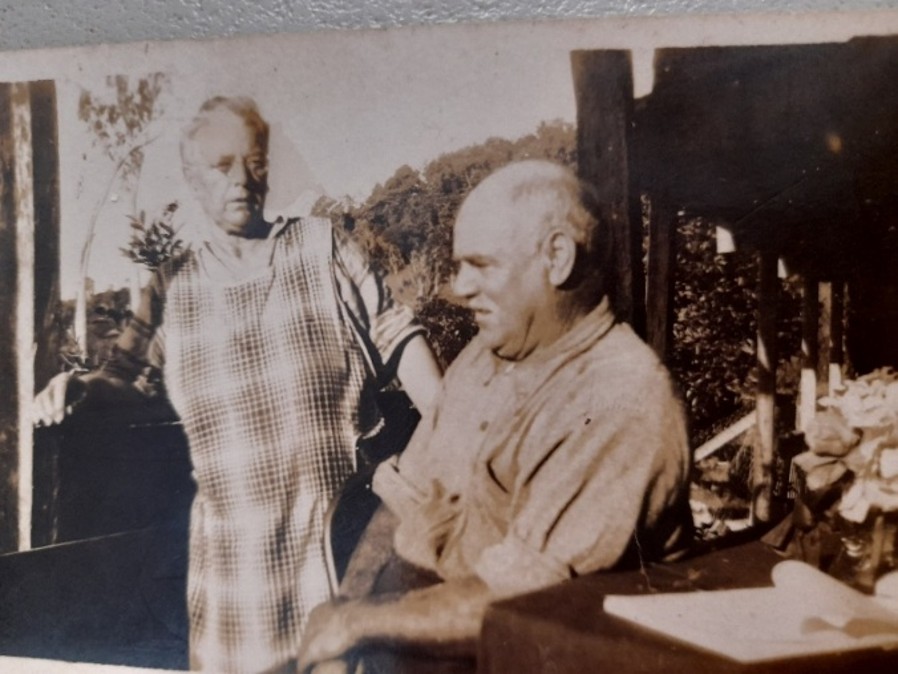 Edith and Ted, image courtesy Robert and Lynda Wildsoet
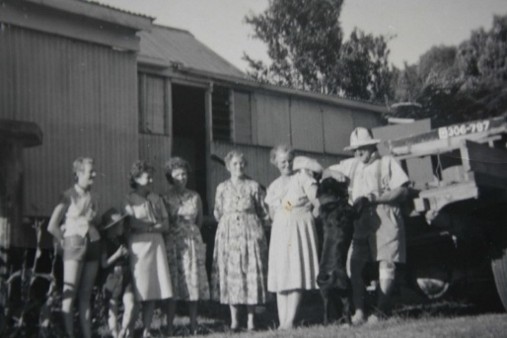 Garner and Wildsoet families at Garners Beach, after 1942. 3rd from left to right: Beryl, Betty and Lilian Wildsoet, Gerty Garner and Ted Garner with dog. From Kay Stephens, nee Wildsoet
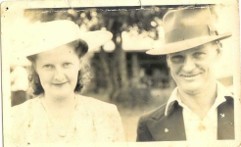 Thelma and Alfred ((Stumpy) Garner. From Ancestry.com, shared by Roslyn Schwenke 2022
|
Abridged Story | |
Full Story |