
Author: Ken Gray
Editors: Margaret Remilton, Rhonda Jarvis, and Diane Bull.
 |
Download PDF |
When war broke out in 1914, the remote coastal settlement of Clump Point (Mission Beach) seemed worlds away from the European battlefields. Yet this small community, with just 36 electors on the 1915 electoral roll, would send four of its men to serve King and country.
Two more veterans would later make their homes here, finding solace in the tropical isolation after witnessing the horrors of war.
The war's impact on the district extended beyond those who served. As the conflict dragged on, coastal shipping virtually disappeared, leaving local farmers stranded without means to transport their produce to market. It was a cruel irony; while their neighbours fought overseas, those who remained struggled to sustain the very community the soldiers had left behind.
HENRY WILLIAM ALLASON
Captain and Island Owner
Henry Allason's life story was certainly intriguing and sad. In 1913, this enterprising Englishman ventured into the wild tropical north of Queensland to become the first European to own Bedarra Island, purchasing both it and nearby Timana Island from the government for £20. His life in tropical paradise was short-lived; after little more than a year, the British Army called him to serve as a Lieutenant in the 3rd Battalion of the East Surrey Regiment.
Henry's war ended not with a bullet wound, but with poison gas used by Germany in the French battlefields. The chemical weapons left him permanently damaged, too weak to return to fight or to his island retreat. He spent his remaining years until 1935 in exile near Nice, France, perhaps finding some comfort in the Mediterranean climate that echoed his lost Queensland home.
CHARLIE (ROLAND CARL) JACKSON
The Mystery Man of Wilford Hill
The Cairns Post of September 22, 1915, announced that Charles Jackson was the first man from Clump Point to enlist, but military records tell a slightly different story. His given name was Roland Carl Jackson, a Sydney-born farmhand working for Ted Garner at Garners Beach, but he was known as Charlie.
Charlie enlisted on September 11, 1915, and rose to Lance Corporal in the 49th Battalion before returning to Queensland. The records show him living in the district from 1912 to 1943, and we now know from his grand-daughter, Julie Jackson, that he returned from the war to settle at El Arish. Jackson Road in El Arish is named after him.
He married Beatrice Williams, a sister of Sam Williams who married Nellie Garner. Beatrice was living with the Garner family at Garners Beach after her parents died when she was only seven years old. The link then was another legacy of the great generosity of the Garners.
ALBERT BRYANT
The Farmer's Tragic Journey
Perhaps no story from this district carries more heartbreak than that of Bert Bryant. At 29, he had built a promising life as a banana and citrus farmer at Mission Beach, working alongside his friend Adam Dewar since 1913. When duty called on January 31, 1916, he left his thriving farm and his girlfriend, Margaret Alexander, to serve his country.
Bert's journey to war was cruelly slow. After a brief visit to his family in Somerset, England, he didn't reach France until March 17, 1917. Twenty-eight days later, on April 15, enemy fire cut him down at Villers-Bretonneux. His brother Robert served on the battlecruiser HMAS Australia, making the Bryant family's sacrifice doubly poignant. Bert served as Private 263 in the 11th Machine Gun Company, one number among thousands, but to Mission Beach, an irreplaceable loss.
GEORGE HENRY WEBB
A Soldier of Three Wars
George Webb was that rare individual who seemed drawn to history's great conflicts. A man of few words but considerable courage, he fought in three major wars spanning four decades. He began with the Boer War in South Africa in 1902, enlisted again from his Mission Beach farm on February 14, 1916, for service in France through 1917, and even in his later years served with the Citizen Military Force in Victoria from 1942-1943.
His remarkable diary, preserved for posterity, offers an intimate glimpse into the mind of a professional soldier who witnessed the evolution of warfare across the early 20th century. His story is told more fully in George’s Diary on mbhs.com.au.
ARTHUR GARNER
Nephew's Ultimate Sacrifice
Though Arthur Garner hailed from nearby Mundoo rather than Clump Point proper, his connection to the district ran deep. As nephew to local timber mill operators Ted and Edith Garner, he worked at the Cutten mill in Bingil Bay 1909-1910 before the war changed everything.
Arthur's military service reads like a catalogue of the war's bloodiest campaigns. Enlisting with the 19th Infantry Battalion on February 20, 1915, he shipped immediately to Anzac Cove. There he fought in the vicious Hill 60 attacks of August 1915, then held Pope's Hill until evacuation in December.
After training in Egypt, his battalion joined the massive Pozières offensive in July 1916. Following brutal fighting in Belgium, they returned to France for the Flers campaign in November 1916; conditions that war historians later described as the worst ever encountered by the AIF.
Arthur's war ended in February 1917 as his battalion pursued the German retreat to the Hindenburg Line. He never saw the war's end, but his sacrifice helped drive the enemy back toward their final defeat.
VETERANS WHO SETTLED HERE
JAMES HENRY (HARRY) PLUMB
From Gallipoli to Bingil Bay
Harry Plumb's war began when he enlisted at Innisfail on April 12, 1915. He joined the 26th Infantry Battalion, and landed at Gallipoli that September, defending those blood-soaked ridges until evacuation.
The war followed Harry through multiple hospitalizations for bronchitis, pneumonia, and finally a severe shrapnel wound to his leg during the successful assault on Lormisset in October 1917. While recovering in Harefield Hospital, England, he found an unexpected gift: he fell in love with Eleanor Elford of Middlesex, whom he married.
Invalided out on August 10, 1919, Harry brought his English bride to North Queensland. He carved a 679-acre cane farm from the bush near the Murray River's mouth in 1924, later settling on 160 acres at Bingil Bay, purchased from the Cutten family. There, despite ongoing pain from his war wounds, he and Eleanor built a fruit farm that sustained them until his death in 1957.
SYDNEY WOODFIELD HARRIS
Soldier #27
Syd Harris was among the first Australians to volunteer for the war and, remarkably, was aboard the first troop ship to leave Australia in World War I. He enlisted in Townsville in August 1914, rising through the ranks to Warrant Officer before returning in 1921 to create a vanilla plantation at Mission Beach.
He died soon after in a fire while clearing his land. His full story, as told in Soldier #27 on mbhs.com.au, demonstrates how a notable and dedicated veteran channelled his wartime discipline into pioneering a new agricultural venture in the tropics.
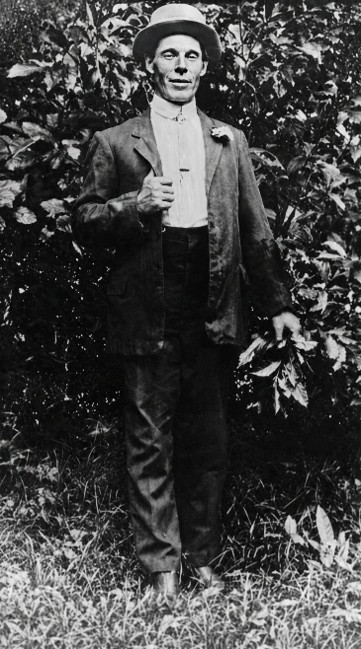 Bert Bryant. Photo by Margaret Bunting nee Alexander
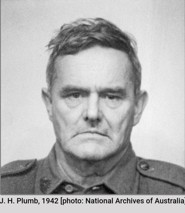 Harry Plumb 1942
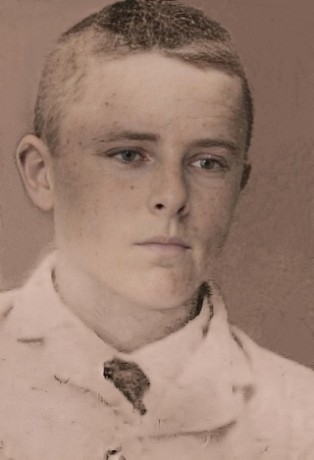 Syd Harris age c. 11.
The El Arish settlement, established after the war on government land reserved for returned soldiers to farm sugar cane, stands as a lasting reminder of the government's recognition that these men deserved more than medals; they deserved a chance to rebuild their lives in the land they had fought to defend.
|
Download PDF |