Author: Ken Gray
Editors: Margaret Remilton, Rhonda Jarvis, and Diane Bull.
 |
Download PDF |
This was utterly incongruous. Who could imagine a war reaching Mission Beach? One of the most peaceful places on the planet, nestled in ancient rainforests and cradled safely by the Great Barrier Reef. Could battleships and bombers step in and take over these beautiful beaches and islands?
Cassowaries have the occasional quarrel, but this is where you would expect to find naturalists and artists, not rear admirals with war machines. Yet during WWII, this peaceful corner of Queensland played a critical, if largely undisclosed and forgotten, role in the Allied victory in the Pacific.
Between 1942 and 1943, Mission Beach became one of Australia's most important naval havens, a secret chemical warfare testing ground, and home to a vital radar installation. Few visitors today realize they're walking through a place where 3,600 sailors once trained for battle, where bombers dropped mustard gas in classified experiments, and where radar operators scanned the horizon for Japanese threats.
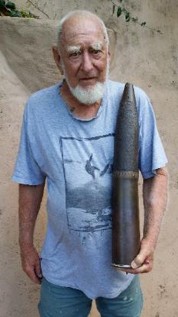 Dave Nissen: with evidence.
Uncovering this hidden history required considerable detective work. Official records were sparse, especially for the classified chemical warfare experiments. Hints came from local witnesses: Dave Nissen, whose father was a coastal watcher here; Peter and Don Wheatley, who were boys during the war and saw everything unfold. Don was 90 when interviewed in 2019, yet he recalled many events. Their testimonies led to newly discovered military records and photographs that revealed Mission Beach's remarkable wartime secrets and helped us to dispel a few myths.
TASK FORCE 44 ARRIVES
On October 13, 1942, HMAS Australia II led Task Force 44 (TF44) into Mission Beach’s peaceful waters. For some of the crew, it was almost a reunion; they'd visited Dunk Island five years earlier for the opening of Hugo Brassey's resort dance hall, complete with the ship's band and the Governor General. Now they returned for grimmer purposes.
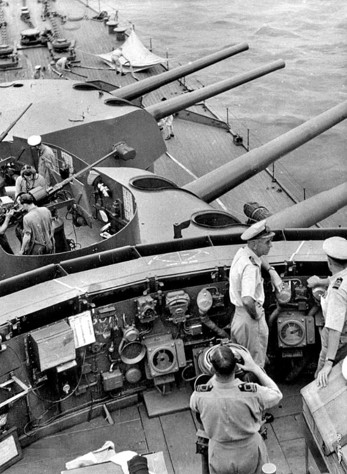 Bridge of HMAS Australia II, courtesy of Australian War Museum.
TF44 was Australia's primary naval assault force: three cruisers (HMAS Australia II, USS Phoenix, HMAS Hobart) and several destroyers, tasked with protecting northeastern Australia and southern New Guinea from invasion. The Royal Australian Navy had already lost three of its five modern cruisers, including HMAS Canberra at the disastrous Battle of Savo Island. That was the Allies’ worst naval defeat of the Pacific War, where four heavy cruisers were lost.
The surviving fleet desperately needed training to prevent future losses and a haven to resupply, repair ships, and receive vital rest and recreation. What better place for that than Mission Beach and its tropical islands?
TRAINING BETWEEN THE ISLANDS
Mission Beach offered the perfect sanctuary. Between three-week Coral Sea patrols, TF44 ships anchored near Dunk Island for intensive battle exercises and resupply. American and Australian crews, fighting together for the first time, practiced everything from radar calibration and aircraft defense manoeuvres to anti-submarine warfare. They exchanged personnel to learn each other's methods under joint US Navy command.
The peak came in March 1943, when 3,600 sailors were stationed here. They trained hard but also found time for football on the beach, fishing from ship sides, and forging friendships with allies and locals. Mission Beach residents provided small boats for recreational use and joined in the fun to help stressed sailors recuperate and build their confidence for their next tour.
HMAS Hobart visited our district 23 times during WWII, more than any other naval vessel. Lieutenant John Stokes of HMAS Australia II captured the atmosphere:
Good days they were, when afternoons could be spent playing football or swimming and men picnicked with billies on the beach …. Friends were made with the inhabitants. There were also afternoons sailing and fishing; there was frequent visiting between ships when Americans and Australians made enduring friendships. There was fishing from the side of the ship (an occupation which usually produced much more laughter than fish) …. A happy, lazy time ….
TRAGEDY AND TRIUMPH
Not all memories were happy. Sub-Lieutenant William Henderson of HMAS Hobart was fatally stung by a marine stinger while swimming at what's now called Wongaling Beach. He's buried at the Townsville War Cemetery.
The training and inter-island battle exercises paid off handsomely. Of the 12 cruisers and destroyers that regularly used Mission Beach as their war shelter, only one, a destroyer named USS Henley, was lost in subsequent battles. The averages for all naval losses during WWII indicate that at least four ships from this Task Force would be expected to be lost during this war. However, something worked here that made these ships safer at war.
These crews went on to extraordinary achievements: HMAS Australia II steamed more miles than any other RAN vessel and survived several kamikaze attacks; USS Phoenix was named one of the US Navy's most efficient ships and sank a Japanese battleship. The TF44 destroyers saved several hundred sailors from sunken ships.
SEPARATING FACT FROM FANTASY
Local legends grew with time, some wildly inaccurate. Claims that the Battle of the Coral Sea was fought 40 nautical miles off the coast of Mission Beach are entirely false; it occurred over 1,000km away near New Guinea. Stories of captured Japanese mini-submarines and mysterious landings of Asian soldiers turned out to be either complete fiction or misidentified American reconnaissance units.
The truth, revealed through careful examination of ship and aircraft logbooks, is remarkable enough without embellishment.
EYES IN THE SKY
In late 1942, the RAAF established a radar station atop Mount Kootaloo on Dunk Island, camouflaged to hide it from enemy aircraft. The facility could detect ships and aircraft 300 miles away in good weather, crucial when Japanese forces posed their greatest threat.
Thirty-five RAAF personnel operated the station, living in the resort cottages and climbing a steep bush track each night to sleep in tents beside their equipment. They provided surveillance and navigation assistance to Allied aircraft and warships until September 1945.
The island's small airfield, built by resort owner Hugo Brassey in 1936, was expanded for emergency landings. Despite this, one bomber still lies on the seabed north of Dunk Island; its wing was once caught in a fishing net but fell back into the depths.
SECRET SQUIRREL STUFF
The war's most mysterious chapter at Mission Beach involved chemical warfare testing. As American forces prepared for horrific battles at Tarawa Atoll, Peleliu, and Okinawa, where Japanese troops used concrete bunkers to devastating effect, the Allies considered using poison gas to save soldiers’ lives. There was a fear also that Japan may resort to chemical warfare as it had done in its invasion of China before the Pacific War.
Britain asked Australia to test chemical weapons in tropical conditions. Mission Beach, with its similarity to Pacific atolls, became one of the testing grounds along with Proserpine and Mourilyan. The main areas of the district involved in chemical warfare experiments were north Mission Beach (aerial spraying of the beach and bombing of the forests) and North Brook Island. Artillery and mortar practice events also occurred in mainland forests.
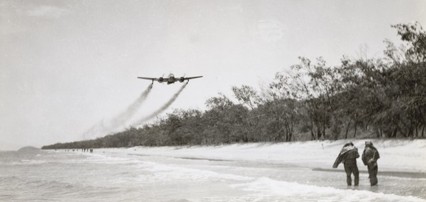 Image AWM P10718 003. Beaufort bomber spraying mustard gas on people below. Mission Beach 1944.
For years, officials denied that gas testing occurred at Mission Beach. The evidence said otherwise: locals remembered white sheets strung in trees to guide bombing runs, and steel pins were found hammered into trunks after the war. Mysterious evacuations also occurred. Finally, and thanks to Peter Dunn and his website, Australia@War, signed RAAF aircraft logs were uncovered and these confirmed the truth.
Between 1944 and 1945, 49 Beaufort bomber flights dropped mustard gas bombs or sprayed thickened chemical mixtures over Mission Beach forests and shoreline. In the most disturbing experiments, volunteers walked roped paths through contaminated forest areas 1-4 days after low-level bombing, wearing only standard uniforms and respirators.
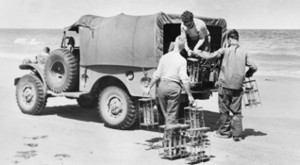 AWM image PO3332 015: December 1944, Mission Beach: Chemistry personnel loading Porton bubblers into a Dodge truck. The bubblers were used for measuring the concentration of gas.
Most volunteers sustained burns; some were hospitalized at Innisfail for two weeks. Remarkably, some volunteered for additional experiments. The Army cordoned off the area during tests, monitoring all entry and exit points, while maintaining total secrecy about the poison gas operations.
Ultimately, chemical weapons were not used by the Allied forces in the Pacific War. Instead, other ways to limit the loss of lives of soldiers invading heavily fortified islands were found such as using bulldozers to destroy buried machine gun nests, but Mission Beach hosted these experiments to ensure Allied preparedness.
A MILITARY ZONE
There was no permanent Army base at Mission Beach during WWII. Four units were based at Tully, one of them being near Feluga. The entire Mission Beach mainland area was declared a military zone. Dunk and Purtaboi Islands became Navy and Airforce Reserves. Residents needed identity cards and special passes to enter or leave the area. Armed guards manned checkpoints at Hoban's Creek and Jones Road, El Arish.
The few dozen permanent residents lived under military oversight while history unfolded around them. Most people had evacuated earlier to south and central Queensland. The small remnant population made the area ideal for such covert, dangerous operations. Before a bombing or artillery event, advertisements were issued in local newspapers and residents were informed if they were nearby the action.
LEGACY OF THE HIDDEN WAR
Mission Beach's important wartime roles remained largely secret for decades. Few people today know much about it, even locals. The naval training that occurred here helped create some of the Pacific War's most successful ships and crews. The radar station provided early warning during Japan's greatest threat. The chemical weapons testing, however ethically troubling, represented the Allies' determination to prepare for the worst contingencies and end the war quickly.
Today, cassowaries wander forests that were once bombed. The only visible reminders are rusting radar equipment on Mount Kootaloo and a navigation beacon on Taylor Reef. A sign that warned of unexploded ordnance near Licuala Walk was removed recently. However, for a period, this peaceful paradise was one of the Pacific War's most important staging areas, a hidden chapter in Australia's wartime story that is now on the public record and deserves to be remembered.
Mission Beach may not have been a battlefield, but it was undoubtedly a crucial piece in the Allied victory puzzle, where paradise temporarily became a vital part of a devastating war.
THOSE WHO SERVED
Locals enlisting from the district who are in the WW2 Nominal Roll include:
- Maxwell Henry Hansen, QX2080, enlisted Townsville 4 November 1939 and discharged as a Private in the Australian Depot Battalion on 24 Mar 1942.
- Edward Wildsoet, Q39571, born at Clump Point. Enlisted Tully 25 January 1940. Discharged 6 Apr 1944 as Private 7 Training Battalion.
- Alfred Marquis Garner, QX7519, born Innisfail, enlisted Cairns 21/5/1940, discharged 27/7/1940, Private 2/15 Battalion.
- Tony English served with the Catalina Squadron at Townsville. He was discharged as a Flying Officer, General Reconnaissance on 16 October 1945.
- Eric Peter Hansen, QX11727, enlisted Townsville on 29 April 1941. Discharged Lance Corporal of 2/4 Australian Commando Squadron 21 Dec 1945.
- Raymond Kinross Garner, B3239, born Innisfail, enlisted Brisbane on 23 July 1941. Discharged as Able Seaman from the Lonsdale Naval Base, 19 Dec 1945.
- Ronald Francis Garner Williams, QX48409, Innisfail, enlisted Charters Towers 31 Dec 1941. Discharged 02 May 1946 Private, 2/21 Supply Platoon.
- Alich Leonard Alexander, QX38567. Clump Point. Enlisted at El Arish 11 January 1942. Discharged as Private 2/2 Machine Gun Battalion, 23 Aug 1946.
- Terence Seary, O18283. Locality Granadilla. Enlisted Brisbane 31 Jan 1942. Discharged 21 February 1946 Flying Officer No. 31 Squadron.
- Leslie Wilfred Morris, QX29977. Enlisted from Dunk Island at Brisbane, 10 February 1942. Discharged as Warrant Officer Class 2 from the 18 Australian Small Ships Company on 18 April 1946. Leslie was a son of George Morris, who was manager of the Dunk Island resort.
- Leslie James Bateson, QX30268. Mission Beach, QLD. Enlisted Brisbane 9 March 1942. Discharged as Corporal, 2/6 Armoured Regiment, 20 Nov 1944.
- Deborah Jean Olsen (nee Wheatley), 99335, born in Petersburgh, USA, lived in South Mission Beach and relocated to Brisbane in 1942. Enlisted Brisbane 12 May 1942. Discharged 26 September 1944 as Sergeant Head Quarters, NE Area.
- Stanley Douglas Garner, QX56361. Born Innisfail, enlisted from El Arish locality at Warwick, 14 August 1943. Discharged as Private of the 2/1 Guard Regiment, 22 Nov 1945.
- Valma Mary Garner, WR/2409, Innisfail. Enlisted 23 Oct 1944 at Brisbane and discharged as Stewardess from the Moreton Naval Base, 2 Oct 1946.
- Hugo Brassey (Dunk Island) enlisted and was the skipper of a small trawler engaged in anti-submarine patrols. Later, he was with a British force attempting to defend Norway in 1940 and was commended for his role there.
Edgar Arthur (Mick) Bell Qx3746 enlisted when living in Tully, and after the war, he and his family moved to a farm at Mission Beach. Mick enlisted with the 2nd AIF on 03 November 1939 and was discharged as a Staff Sergeant 11 December 1944. He served in Tobruk and many other areas and was discharged while in New Guinea when he contracted malaria and meningitis. His daughter, Sylvia, was born in Tully Hospital while he was recovering there.
Timothy Michael Donnelly enlisted with the RAAF 426478 in Brisbane 03 July 1942 and was discharged 19 February 1946 as a Warrant Officer, 62 Squadron. After the war, Tim settled in Mission Beach in 1948 on a farm later owned by Ken Campbell.
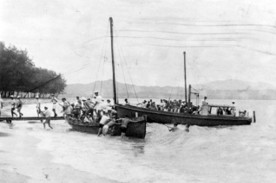 Dunk Island, Qld. Sailors come ashore from two local boats while on liberty. Australian War Museum Collection, donor M. Williams.
This is a small part of the war history. A full account of the war at Mission Beach is told in the eBook by Ken Gray, War and Beach, draft2digital, 2020.
|
Download PDF |