
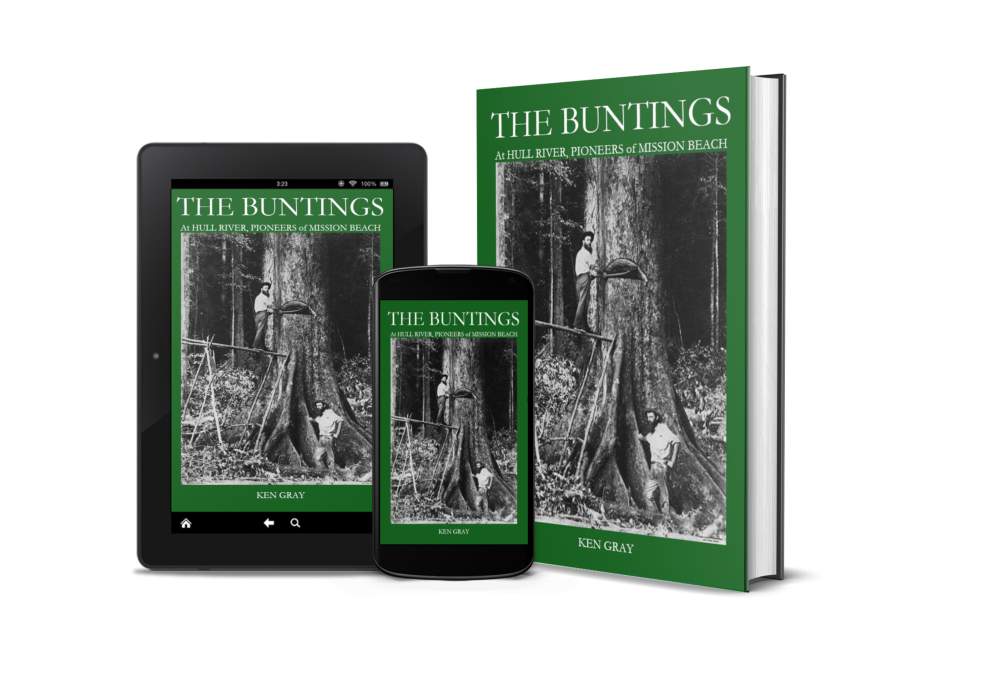
Author: Ken Gray
Editors: Margaret Remilton, Rhonda Jarvis, and Diane Bull.
 |
Abridged Story | |
Full Story |
The story of the Buntings begins not with triumph but with heartbreak. When Margaret Eakin stepped onto Australian soil in 1877 aboard the Scottish Bard, she had already buried two lives: her first husband, lost overboard during the voyage from County Leitrim, Ireland, and her baby, who died the very day they landed. She was just twenty years old.
Four years later, Margaret married John Bunting in Townsville. John had arrived from the small Sussex village of Hundon in 1875, and like Margaret, he was rebuilding a life in a new land. Together, they would become the foundation of one of Mission Beach's most significant pioneering families.
In 1902, the Buntings arrived at Hull River with cattle, intending to be graziers. But drought has a way of redirecting plans. Instead, they turned to the towering forests, rich with silky oak and maple, and became timber getters. John brought his daughter Maud and son Jack with him initially, establishing a camp on the north bank of the Hull near the river mouth. They created what would become known as Buntings Landing, and eventually Silky Oak Landing, a wharf near where Carmoo Creek joins the South Hull.
They lived in bush camps and moved around, including a camp near Sugar Cane Creek where they planted cane to feed their horses. Ted Banfield wrote effusively about their camp in 1915, painting a picture of life there:
Stripped to his waist he smiles genially, as does his father-in-law, a taller man and strong and tough, a yeoman of whom the State may be proud... True as the temper of their own axes, men whose word is above reproach, keen in business, frank in expression, knowing the secrets of the bush…
Banfield described Mrs Bunting's remarkable hospitality, welcoming wayfarers who appeared from apparently nowhere on the road to somewhere equally indefinite with cakes and tea. He painted vivid scenes of timber wagons drawn by fourteen horses, enveloped in white dust almost as impalpable as flour, and Mr Bunting snigging logs with bullocks, exhorting them with his voice alone, the whip held threateningly but seldom used.
The work was gruelling. By 1908, Jack Bunting was making news with his timber operation, reporting nearly 100,000 feet of oak and maple ready for transport to Rooney and Co.'s Ross River mill in Townsville. He shared the story of one exceptional axeman who single-handedly felled, logged, and barked a massive maple yielding 8,000 super feet in a single day, earning £5.
The Buntings gave the district more than timber. Before the gravelled road from Tully to Mission Beach was built in 1940, it was their logging tracks that connected the scattered settlements, allowing families to get supplies and farmers to transport produce. When the council finally built proper roads, they largely followed the Bunting tracks, with Chris Wildsoet (who married Maud Bunting in 1910) recruited to navigate the ideal routes.
In 1917, John and Margaret, now nearing their sixties, returned to their Townsville home in Aitkenvale. John went on to become president of the Aitkenvale Progress Association in 1921 and won awards for his Jersey bulls at the Townsville Show.
Jack remained at the Hull, marrying Margaret Alexander of Bingil Bay in 1919. Margaret came from another iconic pioneering family; her mother Florence was a Cutten. Margaret had been courting Bert Bryant, a Clump Point farmer, but Bert enlisted in WWI and was killed in France in 1917.
In 1916, Maud Wildsoet and Margaret Bunting catered for 42 people at a board of enquiry meeting, a remarkable feat in such a remote location.
Jack and Margaret raised seven children: Leslie, Florence, Dorothy, Albert, Elizabeth, Sidney, and Muriel. They remained until WWII, when Japanese threats forced them to relocate to Charters Towers around 1939.
Jack worked on the Breddan Airfield and other wartime projects with the Civil Construction Corps during WWII. After the war, he worked as a Foreman Bridge Carpenter for Main Roads and then for the railways. He was always held in high regard for his work skills and ethics.
Albert Edward lived only to twenty-four. In May 1921, while working as a clerk in Townsville, he travelled alone to Brisbane and took his own life. No explanation was given for his tragic end.
Jack and Margaret's children grew up in the bush with the uncertainties of war: Florence had a son Douglas before marrying Jim Jones. In 1955, when Douglas was ten, he was adopted by his grandparents Jack and Margaret. As of 2024, Doug appears to be the only surviving member of the Mission Beach Bunting family. Doug married Mavis Pearn and served in the Royal Australian Navy as a submariner, as did his son Geordie for 20 years.
Dorothy (Dot) worked on farms and in hotels before meeting Frank Bowen at a dance in Charters Towers during WWII. Frank served in the Middle East and New Guinea. After the war, they moved around then settled in Mount Isa where Frank worked for the mines and was a volunteer fundraiser for charities. Albert (Bob) and Sidney never married.
The Buntings were our most significant timber-getters, living in the district for forty years and they built the tracks that connected the community. From Margaret's devastating arrival in Australia to her grandchildren's generation scattered across Queensland, the Bunting story is one of adaptation, hard work, and community building. They are remembered by Bunting Court and somewhere in the forest behind Holland Street, a traction engine slowly returns to earth, a monument to the ambition that once moved tons of timber to the world beyond.
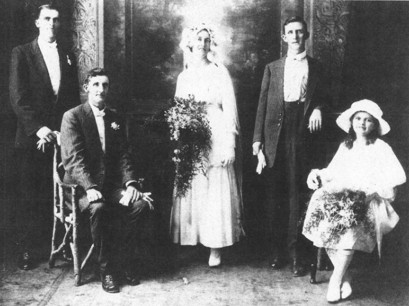 Marriage of Jack & Margaret Bunting, 1919. Les Alexander, Jack Bunting, Margaret Alexander, Albert Bunting, flower girl, Isabel Cutten, James and May Cutten’s daughter. Images from Doug & Mavis Bunting.
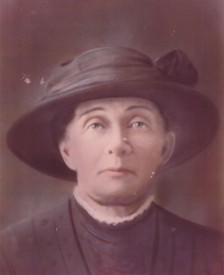 Margaret Bunting.
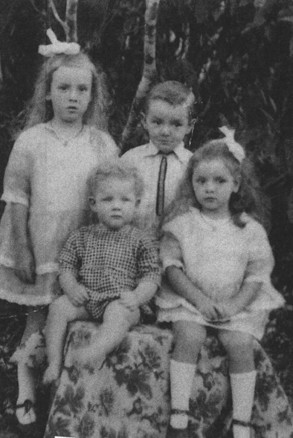 Bunting children 1920s: Florence, Leslie, Bob (Albert) and Dorothy.
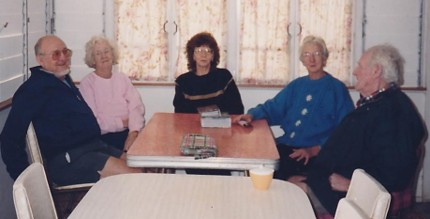 Descendants: Doug Bunting, Florence Jones nee Bunting, Mavis Bunting, Dorothy Bowen nee Bunting, Bob (Albert) Bunting. Charters Towers 1995. Image Doug Bunting.
|
Abridged Story | |
Full Story |